| Format | Year | Patent licensing | Streaming targets |
|---|
| HDR10 | 2015 | Royalty-free | Most streaming, Blu-ray |
| HDR10+ | 2017 | Free for content licensing | Samsung, Amazon Prime |
| Dolby Vision | 2014 | Per-content licensing | Apple TV+, Netflix premium |
| HLG | 2015 | Royalty-free | Broadcast, BBC, NHK |
HDR10+ is royalty-free at content level. Dolby Vision charges per-title licensing fees. For independent productions: HDR10+ is significantly cheaper.
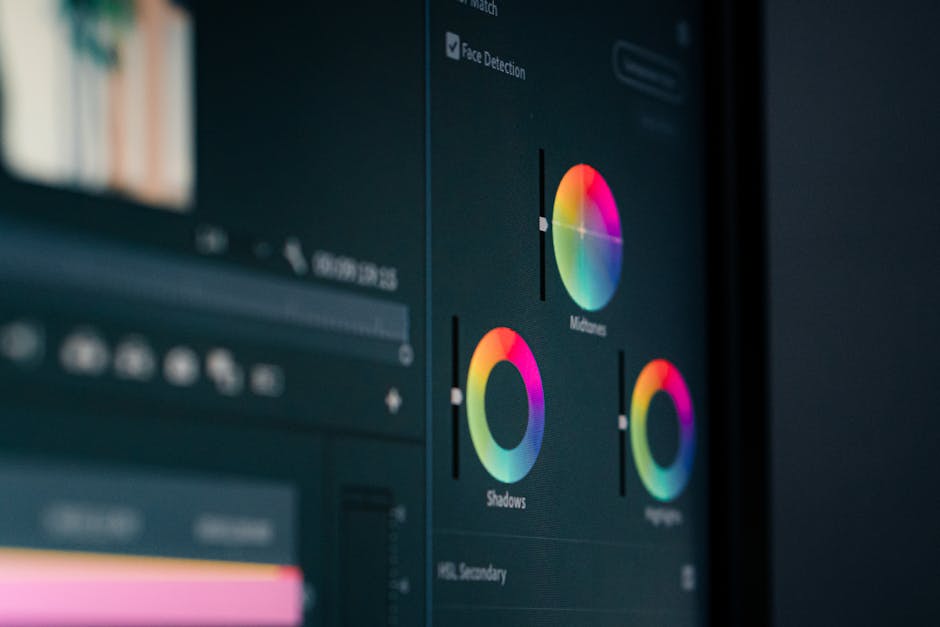
DaVinci Resolve Studio (paid) supports both HDR10+ and Dolby Vision. The setup differs:
- Project Settings > Color Management > DaVinci YRGB Color Managed
- Output Color Space: Rec.2020 ST.2084 1000 nits
- Color page > Pipeline > Insert HDR10+ Tools (paid plugin)
- Per-shot: tag with HDR10+ analysis
- Deliver page > Format: MP4 / Codec: H.265 / HDR10+ metadata: On
The HDR10+ Tools analyze scene brightness automatically. For each shot, the system embeds optimal tone mapping parameters into the file.
- Project Settings > Color Management > Dolby Vision Color Pipeline
- Output Color Space: Rec.2020 ST.2084 4000 nits
- Color page > Dolby Vision Trim Pass:
- Master at 4000 nits (creative intent)
- Trim to 100 nits (SDR)
- Trim to 1000 nits (typical TV)
- Trim to 600 nits (some mobile)
- Deliver page > Format: MOV / Codec: ProRes / Dolby Vision XML: On
Dolby Vision requires more authoring work because of the trim pass. For a 90-minute film, expect 2-3x the color grading time vs HDR10+.
| Service | HDR10 | HDR10+ | Dolby Vision |
|---|
| Apple TV+ | No | No | Yes (Profile 5) |
| Netflix Premium | Yes | No | Yes |
| Amazon Prime | Yes | Yes | Yes |
| Disney+ | Yes | No | Yes |
| Vimeo Pro | Yes | No | Yes (selective) |
| Google Play | Yes | Limited | Yes |
| YouTube | Yes | No | No (HDR10 only) |
For Apple's ecosystem: Dolby Vision only. For broader streaming: HDR10 baseline plus HDR10+ for Samsung-friendly viewers and Dolby Vision for premium-tier subscribers.
| Master nits target | Use case |
|---|
| 100 nits (SDR) | Reference SDR delivery |
| 600 nits | Conservative HDR (mobile-friendly) |
| 1000 nits | Standard HDR mastering |
| 2000 nits | High-end HDR (premium TVs) |
| 4000 nits | Dolby Vision creative intent |
| 10,000 nits | Theoretical maximum (no display has this) |
For practical 2026 deliverables: 1000 nits master for most projects. 4000 nits for hero hero shots intended for top-tier TVs.
For underlying nit-level mastering, see Sony FX3 and FX6 S-Log3.
For HDR10+ mastering:
- HDR-capable monitor (1000+ nits, Rec.2020 coverage)
- Color management calibration (X-Rite i1, Klein K-10A)
- DaVinci Resolve Studio with HDR10+ Tools
For Dolby Vision mastering:
- Reference HDR monitor (Sony BVM-X300, Eizo CG3146)
- Dolby Vision Mastering Display (specific certified models)
- DaVinci Resolve Studio with Dolby Vision license
The Dolby Vision Mastering Display certification is expensive. Studios charge $2,000-5,000 for Dolby Vision-capable monitors with proper calibration.
For a 90-minute film mastered at 1000 nits:
| Format | File size |
|---|
| HDR10 master (ProRes 4444 XQ) | 700 GB |
| HDR10+ master (HEVC + side metadata) | 12 GB delivery |
| Dolby Vision Profile 5 master (HEVC + XML) | 13 GB delivery |
| Dolby Vision Profile 7 (dual-layer) | 22 GB delivery |
| H.264 SDR delivery (1080p) | 4 GB |
For streaming delivery, the metadata adds under 1% to file size. The base HEVC encoding is the bulk.
For HDR10+ encoding via FFmpeg:
ffmpeg -i master.mov \
  -c:v libx265 -preset slow -crf 18 \
  -pix_fmt yuv420p10le \
  -x265-params "hdr10=1:hdr10_opt=1:colorprim=bt2020:transfer=smpte2084:colormatrix=bt2020nc:master-display=G(13250,34500)B(7500,3000)R(34000,16000)WP(15635,16450)L(10000000,1):max-cll=1000,400" \
  -metadata:s:v handler="HDR10+ Metadata" \
  output.hdr10plus.mp4
The HDR10+ metadata is embedded in the H.265 stream. Players that support HDR10+ apply it; non-supporting players fall back to HDR10.
For broader HDR encoding context, see VVC vs AV1.
Dolby Vision encoding is more complex; it requires the Dolby Vision XML file alongside the encode:
# Profile 5 (single-layer, used by streaming services)
dovi_tool -m 5 -i master.hevc -o output.dovi.hevc

# Combine with metadata
ffmpeg -i output.dovi.hevc -c:v copy -metadata:s:v handler="DolbyVision" output.dovi.mp4
The dovi_tool is open-source (GitHub) for Dolby Vision processing. Profile 5 is single-layer for streaming; Profile 7 is dual-layer for Blu-ray and similar premium delivery.
| Device | HDR10+ | Dolby Vision |
|---|
| Samsung QLED TVs | Yes | No |
| LG OLED TVs | No | Yes |
| Sony Bravia TVs | Yes | Yes |
| Panasonic OLED | Yes (some models) | Yes |
| Apple TV 4K | No | Yes |
| Amazon Fire TV Cube | Yes | Yes |
| iPhone 15 Pro+ | Limited | Yes |
| Recent flagship Android | Yes | Limited |
| Game consoles (PS5, Series X) | Yes | Yes |
For maximum reach: master to HDR10 base, deliver HDR10+ to Samsung-friendly platforms, Dolby Vision to Apple/Netflix premium tiers.
For underlying device support, see HDR10 vs Dolby Vision Conversion.
Tone mapping mismatched on display: master display value wrong for the actual reference. Verify master-display parameter matches your monitor.
HDR10+ shows as HDR10: HDR10+ metadata stripped or unsupported by player. Verify with MediaInfo that HDR10+ atoms are present.
Dolby Vision XML rejected by encoder: format mismatch with profile (5 vs 7). Convert XML to correct profile.
Highlights too dim on premium TV: master not bright enough for the TV's capability. Master at 1000+ nits for proper highlight headroom.
Skin tones unnatural in HDR: saturation too high. HDR has wider gamut; reduce saturation 5-10% from SDR habits.
For ACES integration, see ACES Color Pipeline.
If targeting Apple TV+ or Netflix premium: Dolby Vision (required). If Samsung-friendly streaming or budget independence: HDR10+. For broadest reach: master to HDR10 base, generate both HDR10+ and Dolby Vision deliverables.
For YouTube and most streaming: HDR10 baseline is sufficient. Dynamic metadata is incremental polish.
Per-content licensing for Dolby Vision: $0.005-0.05 per stream/sale. For high-volume content: significant. HDR10+ is royalty-free at content level.
Hard. The tone mapping for 4000 nits master to 1000 nits monitor is approximate. Master at the brightness your reference can show; trim to higher brightness if delivering to those displays.
HLG (Hybrid Log-Gamma) is the broadcast HDR format. Doesn't have dynamic metadata. Used for live broadcast (BBC, NHK) where dynamic metadata workflows aren't practical.
iPhone 14 Pro+ records Dolby Vision (Profile 8.4 specifically). Not HDR10+. For HDR10+ recording: Samsung Galaxy S24+, certain professional cameras.
For premium streaming HDR mastering: Dolby Vision for Apple/Netflix premium tiers, HDR10+ for Samsung-friendly delivery, HDR10 baseline for broad streaming. DaVinci Resolve Studio with proper HDR-capable monitor is the production toolchain. Our video compressor handles SDR delivery alongside HDR for non-HDR audiences.